The Man Behind The Name
Some pseudonyms are chosen for privacy. Others are chosen as statements.
Kapelwa Musonda belonged firmly in the second category.
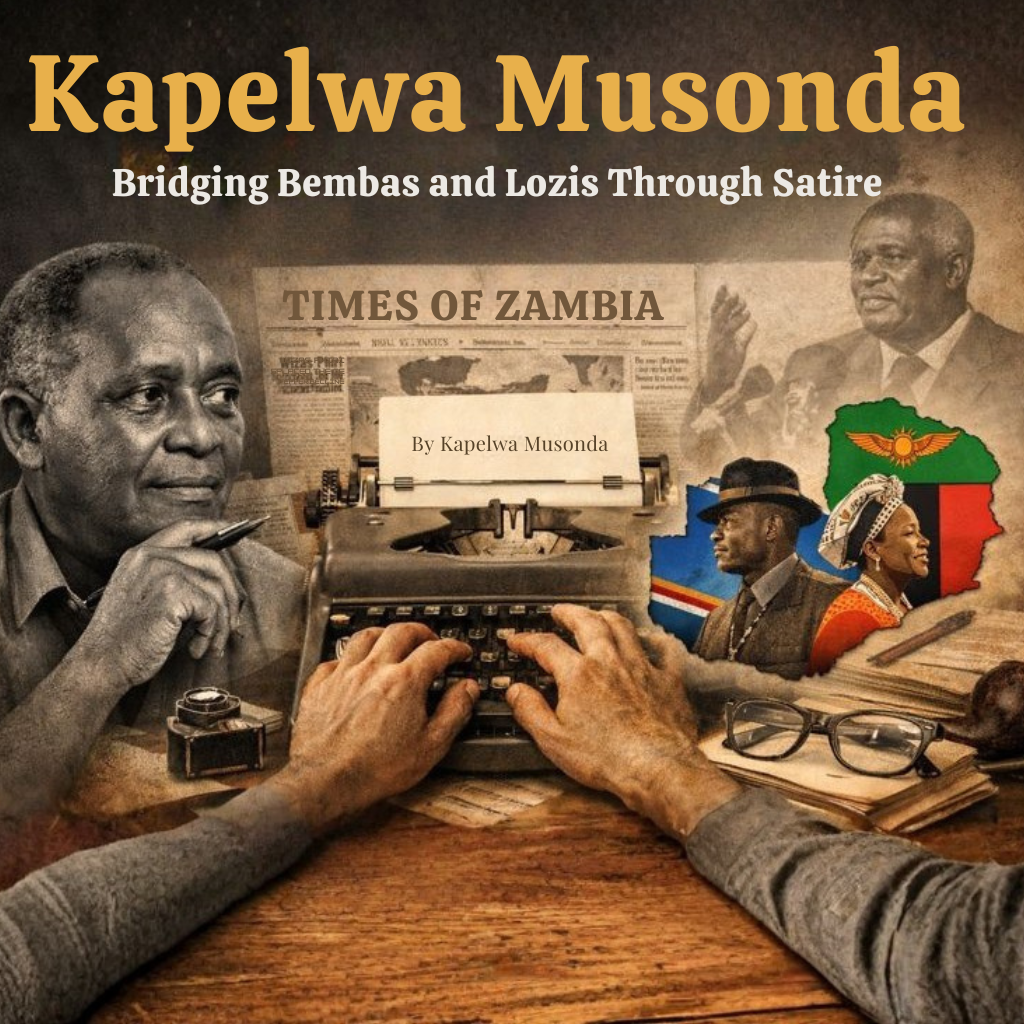
Long before social media rewarded outrage and tribal shortcuts, Zambia had a writer who understood something subtle: that tension does not always need confrontation — sometimes it needs disarming. His tool was satire. His shield was a name carefully designed to mean more than the person behind it. His writings regularly featured in his column in the Times of Zambia newspaper in the 1970s-1980s.
Kapelwa Musonda was never meant to represent one tribe, one region, or one political camp. The name itself was a deliberate blending, signalling coexistence at a time when public discourse often leaned toward division rather than unity.
Writing as a Pressure Valve
Zambia in the early decades after independence was still negotiating identity — politically, economically, and socially. Some rivalries were real, others amplified by suspicion and rhetoric. What mattered was not whether tension existed, but whether it would be allowed to harden.
Kapelwa Musonda’s writing worked because it refused to escalate. Instead of arguing directly with tribal narratives, it made them look small. Instead of naming enemies, it exposed absurdities. Readers laughed — and in laughing, stepped back from the edge.
That is a rare skill. Satire is easy when it punches down or confirms bias. It is much harder when it quietly dissolves it.
Fictional Voices, Real Insight
The strength of the column lay in its characters — ordinary, recognisable figures whose conversations mirrored those happening in bars, markets, buses, and homes. Through them, national politics became familiar rather than intimidating.
These were not heroes or villains. They were exaggerated versions of ourselves. And that was the point.
By removing personal ownership from the argument—through satire, fictional characters, or neutral framing—people could engage intellectually first, not emotionally. They could argue, laugh, disagree, and reflect without feeling accused or exposed.
This is a skill that he brought to the table. No name-calling or insults. By stripping issues of personal and tribal ownership, the conversation moved from emotion to reasoning.
Why the Name Still Matters
Today, Kapelwa Musonda is often remembered for humour. That risks missing the deeper intent.
The pseudonym itself was part of the message:
that identities overlap,
that coexistence is already happening whether we acknowledge it or not,
and that insisting on rigid divisions often says more about fear than reality.
In that sense, Kapelwa Musonda was not just a columnist. It was a cultural intervention.
Memory, Preservation, and the Present Moment
In an era where commentary is instant and disposable, it’s easy to forget that writing once carried longer responsibility. Columns were reread. Characters became familiar. Ideas lingered.
That legacy matters — not as nostalgia, but as instruction.
If Zambia navigated moments of perceived division before without tearing itself apart, it wasn’t by accident. It was helped along by people who chose language carefully, understood audience psychology, and valued cohesion over applause.
Kapelwa Musonda was one of those people.
A Story Worth Revisiting
A recent Facebook post reflecting on this legacy offers a reminder of how cultural memory survives — not through formal archives alone, but through people choosing to remember and share.
Catherine Pule’s wonderful post on Kalemba, reveals the man behind the name:
👉 https://www.facebook.com/share/p/1BpktH8Tuh/
It’s a short read. But it opens a longer conversation — about how much influence writing can have when it is guided by restraint, intelligence, and an understanding of the society it speaks to.
That lesson remains relevant. Perhaps more than ever.