Ngoma Ya Bakoko – Drums of the Ancestors: Lyrics and English Translation
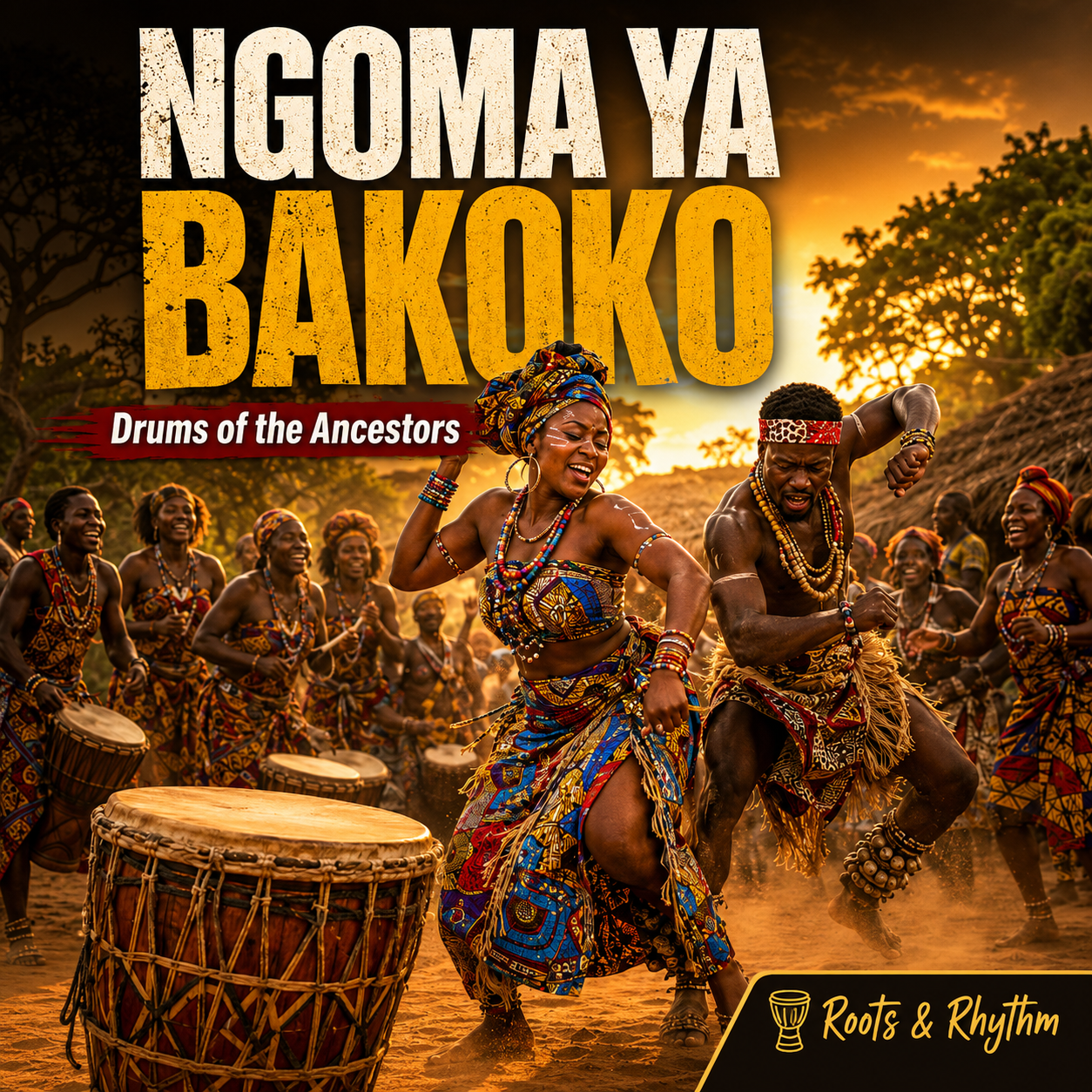
Ngoma Ya Bakoko means “Drums of the Ancestors.”
The song was created as a celebration of Congolese dance, drums, guitar, community and the way music can connect people with memory, identity and tradition.
The lyrics move through several stages. The women answer the drums first. The men then respond with stronger stamping movements. Finally, both groups come together as the sebene begins and the whole celebration explodes into dance.
The song is mainly in Lingala, with repeated dance calls and responses designed to sound natural in a communal performance.
Below is a line-by-line English translation.
Introduction
Ngoma ebengi biso
The drum is calling us.
Ngoma ebengi mboka
The drum is calling the community.
Bana ya Congo, boya
Children of Congo, come.
Tokobina lelo!
We will dance today!
Women answer
Eh mama, toyoki
Yes, mother, we hear it.
Eh mama, tozali awa
Yes, mother, we are here.
Men answer
Eh tata, toyoki
Yes, father, we hear it.
Eh tata, tokoya
Yes, father, we are coming.
Verse 1 – The Women Dance
Basi ya mboka batamboli
The women of the community are moving forward.
Na matambe ya kimia
With calm, measured steps.
Mapeka ezali koloba
The shoulders are speaking.
Loketo ezali koyanola
The hips are answering.
Tokangi bitamba na loketo
We tie our cloths around our waists.
Makolo ekoti na mabele
Our feet are planted into the earth.
Ntango ngoma ebeti mozindo
When the drum beats deeply,
Motema ekomi moto
The heart catches fire.
Women’s Chorus
Bina, mama, bina
Dance, woman, dance.
Lakisa biso nzela
Show us the way.
Bina, mama, bina
Dance, woman, dance.
Mabele eyebi yo
The earth knows you.
Call and Response
Ngoma ezali kobenga nani?
Who is the drum calling?
Ezali kobenga biso!
It is calling us!
Mabele ezali koyoka nani?
Whom does the earth hear?
Ezali koyoka biso!
It hears us!
The women then respond with ululation, a familiar form of vocal celebration heard in many African communities.
Verse 2 – The Men Answer
Mibali ya Congo botelema
Men of Congo, stand up.
Makolo makasi na mabele
Plant your feet firmly on the earth.
Maboko likolo lokola nzete
Raise your arms like trees.
Ntolo liboso, kobanga te
Chest forward, do not be afraid.
Tobina na makasi ya bankoko
We dance with the strength of the ancestors.
Tobeta mabele na lokumu
We strike the earth with respect.
Ntango ngoma epesi elembo
When the drum gives the signal,
Biso nyonso tokoyanola
We will all answer.
Men’s Chorus
Bina, tata, bina
Dance, man, dance.
Lakisa biso makasi
Show us your strength.
Bina, tata, bina
Dance, man, dance.
Ngoma ezali koloba
The drum is speaking.
Call and Response
Banani bakoya liboso?
Who will come forward?
Biso tokoya liboso!
We will come forward!
Banani bakobeta mabele?
Who will stamp the earth?
Biso tokobeta mabele!
We will stamp the earth!
Women and Men Come Together
Basi bamemi kitoko
The women bring beauty.
Mibali bamemi makasi
The men bring strength.
Basi bamemi bomoi
The women bring life.
Mibali bamemi molende
The men bring courage and energy.
Soki tokutani na libina
When we meet in the dance,
Mboka mobimba ekosepela
The whole community will rejoice.
Soki ngoma na guitare ekutani
When the drum and guitar meet,
Butu mobimba tokobina
We will dance all night.
Main Chorus
Ngoma ya bakoko, beta!
Drum of the ancestors, play!
Beta kino mabele eningana
Play until the earth shakes.
Ngoma ya bakoko, loba!
Drum of the ancestors, speak!
Loba na motema ya bana
Speak to the hearts of the children.
Ngoma ya bakoko, beta!
Drum of the ancestors, play!
Basi na mibali babina
Let the women and men dance.
Ngoma ya bakoko, loba!
Drum of the ancestors, speak!
Congo mobimba eyoka
Let all of Congo hear.
The Sebene Begins
The sebene is the point where the guitars become more repetitive, energetic and dance-driven.
In the song, the arrival of the sebene is announced gradually.
Boyoki guitare ezali koya?
Can you hear the guitar coming?
Toyoki yango!
We hear it!
Boyoki bass ezali kotambola?
Can you hear the bass moving?
Toyoki yango!
We hear it!
Ngoma ezali kosala nini?
What is the drum doing?
Ezali komata!
It is building!
Mabina ezali kosala nini?
What is the dancing doing?
Ezali kopela!
It is catching fire!
Then comes the call:
Bongo sikoyo… SEBENE!
And now… SEBENE!
Sebene Dance Calls
During the sebene, the words become shorter because they are designed mainly to direct and energise the dancers.
Basi na loboko ya mobali!
Women, take the man’s hand!
Mibali na loboko ya mwasi!
Men, take the woman’s hand!
Bosala cercle!
Make a circle!
Bofungola nzela!
Open the way!
Bozonga na kati!
Come back into the centre!
Eh, mama, ningisa mapeka!
Woman, shake your shoulders!
Eh, tata, beta makolo!
Man, stamp your feet!
Likolo!
Up!
Na se!
Down!
Baluka!
Turn!
Zonga!
Come back!
Women’s Dance Calls
Basi, tokende!
Women, let us go!
Tokende na loboko!
Move with the hands!
Tokende na loketo!
Move with the hips!
Tokende na matambe!
Move with the steps!
Eh-eh, tokobina!
Yes, we will dance!
Men’s Dance Calls
Mibali, botelema!
Men, stand up!
Bokita na mabele!
Go down toward the ground!
Bobeta mbala mibale!
Stamp twice!
Bobaluka sikoyo!
Turn now!
Tokobina!
We will dance!
Final Chorus
Ngoma ya bakoko, beta!
Drum of the ancestors, play!
Beta kino tongo etana
Play until morning comes.
Ngoma ya bakoko, loba!
Drum of the ancestors, speak!
Biso nyonso tozali bana
We are all children.
Basi babina na kitoko
The women dance with grace.
Mibali babina na makasi
The men dance with strength.
Lelo tozongi na misisa
Today we return to our roots.
Lelo Congo ezali moko
Today Congo is one.
Ngoma ya bakoko, beta!
Drum of the ancestors, play!
Beta kino mabele eningana
Play until the earth shakes.
Ngoma ya bakoko, loba!
Drum of the ancestors, speak!
Congo mobimba eyoka
Let all of Congo hear.
What Is the Song About?
At its heart, Ngoma Ya Bakoko is about the drum acting almost like a voice.
It calls the dancers.
The women answer.
The men answer.
The guitar joins the drums.
Then individual dancers become a community.
The phrase “Ngoma ya bakoko” is deliberately symbolic. It does not refer to one particular historical ritual or one specific Congolese ethnic group. Instead, the song uses the drum as a broader image of memory, ancestry, community and cultural continuity.
Likewise, the dance described in the song is inspired by the rich traditions of Congolese communal dance rather than being presented as a reconstruction of one named traditional dance.
This distinction matters because the Democratic Republic of Congo contains many ethnic groups, languages, musical traditions and dance forms.
What Is Sebene?
For listeners unfamiliar with Congolese music, sebene is one of the most exciting features of Congolese rumba and soukous.
It is usually an extended instrumental section in which the guitars repeat and develop short rhythmic phrases while the bass and percussion drive the dancers forward.
Vocals often change from full verses to short calls, names, instructions and responses.
In Ngoma Ya Bakoko, the sebene represents the moment when the traditional drum-driven celebration and the characteristic Congolese guitar sound finally meet.
That is why the lyric says:
Soki ngoma na guitare ekutani
Butu mobimba tokobina
When the drum and guitar meet,
we will dance all night.
Watch Ngoma Ya Bakoko
If you discovered this page after watching the song on the Roots & Rhythm – Zed Music Lab YouTube channel, thank you for wanting to understand the words as well as the music.
The aim of Roots & Rhythm is not simply to create songs that sound good. We also want listeners from outside Central Africa to be able to understand some of the language, ideas and musical vocabulary behind the songs.
If there is another Roots & Rhythm song whose Lingala lyrics you would like translated into English, leave a comment on the YouTube video.
We may translate that one next.