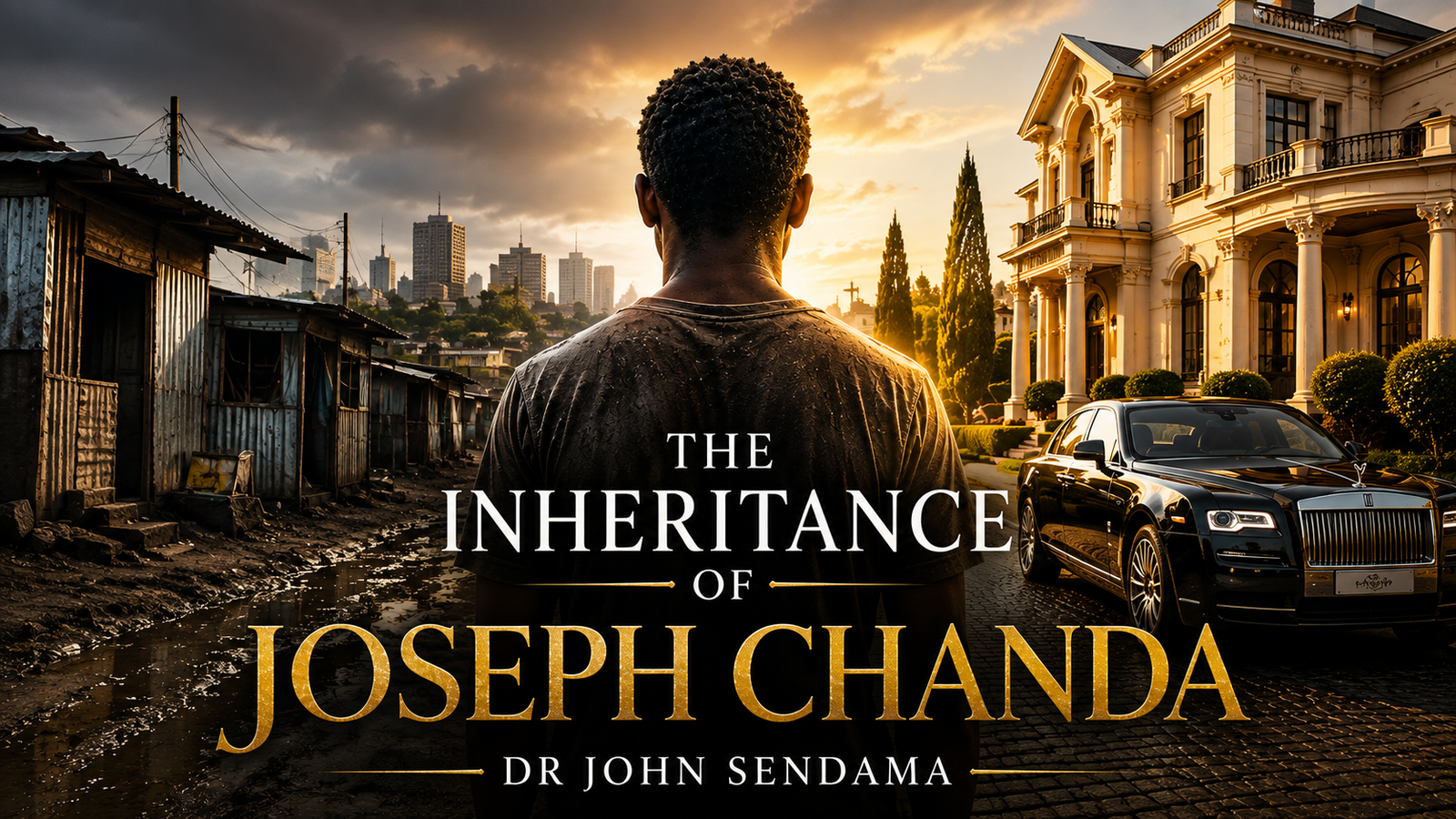
When Does Helping Someone Become a Violation?
What if you could completely transform a poor man’s life for the better — but to do it, you had to lie to him?
That question became the seed for my new work of fiction, The Inheritance of Joseph Chanda.
It began with a rather disturbing idea.
Imagine a wealthy man meeting someone living in severe poverty. Instead of simply giving him money, offering him employment or providing conventional charity, the wealthy man devises an extraordinary plan.
He will persuade the poor man that he was never really poor.
He will make him believe that he has suffered some form of memory disturbance and has simply forgotten who he really is.
And who is he supposedly?
The missing heir to a wealthy family.
From that premise came Joseph Chanda.
A Man, a Mango and Seven Kwacha
When we first meet Joseph, he has seven kwacha in his pocket, a broken sandal and nowhere secure to sleep.
He is standing outside the wall of a wealthy home in Lusaka, contemplating whether he can reach a mango hanging from a tree.
The owner of the house, businessman Gabriel Mwewa, sees him.
That encounter changes both their lives.
Gabriel notices that Joseph bears an extraordinary resemblance to Jonathan, his long-missing nephew and heir.
There are photographs.
There are old records.
There are scars that seem to match.
Gradually, an unsettling possibility is placed before Joseph:
What if the life he remembers isn’t his real life?
What if poverty is not where he came from?
What if he belongs on the other side of the wall?
But Is It Kindness?
This is where the story interested me most.
It would have been easy to make Gabriel a villain.
I didn’t want to do that.
Gabriel genuinely believes that he is improving Joseph’s life.
And in many ways, he does.
Joseph gains security.
He receives opportunities he could never previously have imagined.
He enters rooms where important decisions are made.
And something unexpected happens.
Joseph’s experience of poverty gives him an understanding that many of the wealthy people around him lack.
When a business report describes inadequate housing as a minor maintenance problem, Joseph knows what that means to the family actually living there.
When people are described as an inconvenience to a development project, Joseph understands what it means to have nowhere to sleep.
His presence begins changing decisions.
So the deception doesn’t merely benefit Joseph.
Other people benefit too.
That creates the uncomfortable question at the heart of the book:
If a lie genuinely improves someone’s life — and produces real good for other people — does that make the lie morally defensible?

The Problem of Benevolent Control
There is another side to the question.
Gabriel may be giving Joseph wealth, opportunity and security.
But he is also doing something much more dangerous.
He is asking Joseph to distrust himself.
Joseph remembers his mother.
He remembers growing up poor.
He remembers fragments of childhood.
But what happens when photographs, documents, doctors and respectable people begin suggesting that your memories may not be reliable?
At what point does generosity become control?
There is a profound difference between saying:
“I want to help you.”
and:
“I know what your life should be better than you do.”
That distinction became increasingly important as I wrote the story.
Gabriel’s intentions matter.
But good intentions don’t automatically give us moral permission to interfere with another person’s identity.
Why Set the Story in Zambia?
I wanted Joseph’s world to feel recognisable.
The contrast between wealth and poverty doesn’t require an imaginary country.
We see it around us.
A high wall can separate very different lives.
On one side may be security, vehicles, gardens, electricity and opportunity.
On the other may be somebody calculating what they can afford to eat that evening.
But The Inheritance of Joseph Chanda isn’t intended as a simple story about rich people and poor people.
Joseph isn’t morally superior because he is poor.
Gabriel isn’t morally corrupt because he is wealthy.
Both assumptions would make the story much less interesting.
Instead, the story asks what happens when two people with radically different experiences of life begin changing one another.
And eventually loving one another.
That makes the moral problem considerably harder.
The Question I Didn’t Want to Answer for the Reader
While developing the story, I became increasingly convinced that it shouldn’t end by telling the reader what to think.
Was Gabriel wrong?
In one important sense, absolutely.
But suppose Joseph’s life becomes demonstrably better.
Suppose other lives improve because Joseph was given access to wealth and influence.
Suppose genuine affection grows out of something that began dishonestly.
Discovering that the foundation was wrong doesn’t magically make everything built upon it unreal.
That leaves Joseph — and hopefully the reader — facing a much more difficult question:
What do you do with good things that came from something that should never have happened?
There are no comfortable answers.
That is precisely why I wanted to write the story.
The Inheritance of Joseph Chanda
The Inheritance of Joseph Chanda is a short literary work set in Zambia about wealth, poverty, memory, identity, generosity and control.
At its centre are two men.
One has almost nothing.
The other has enough money to transform another person’s life.
The tragedy is that Gabriel comes to believe that having the power to transform Joseph’s life also gives him the right to decide what that life should be.
And Joseph eventually has to decide what belongs to him:
the wealth,
the memories,
the relationships,
the truth —
and, ultimately, himself.
The Inheritance of Joseph Chanda
By Dr John Sendama
Some gifts can be returned.
Some inheritances cannot.